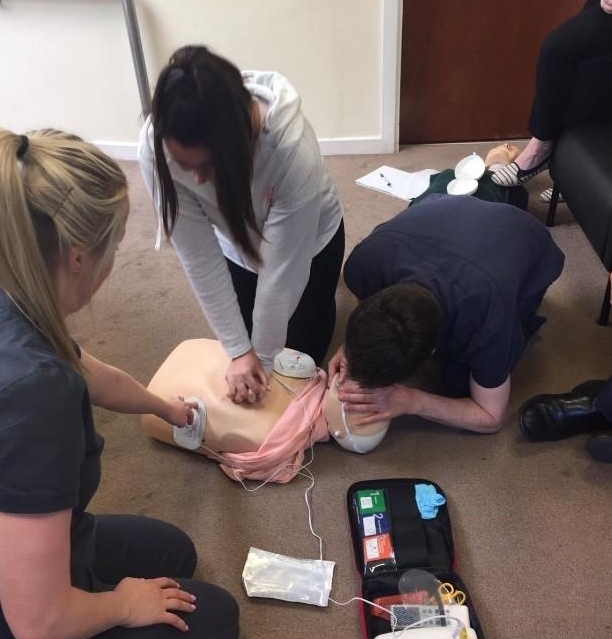

Yesterday at Swords Ortho we completed a refresher BLS ( Basic life support ) course.
BLS (Basic life support) is a level of medical care which is used for victims of life threatening illnesses or injuries until they can be given full medical care at a hospital.
As we work in healthcare we are required to be certified in Basic Life support.
We had a certified trainer call out to the practice and teach us about the changes which had been made to the basic life support guidelines and run through everything again with us as it had been two years since we had our last one. This was provided through practical and theory sessions. We also had a chance to practice with mannequins and use equipment like face masks and an AED. An AED is an Automated External Defibrillator, it is a portable electronic device that automatically diagnosis the life threatening cardiac arrhythmias of ventricular fibrillation and ventricular tachycardia.
We spent the day educating ourselves on basic life support so that if we are ever put in a situation where one of our patients fall ill and is in need of medical assistance, we know exactly what to do in order to help.
Swords village has two defibrillators in case of emergencies. One Is located just outside the Fingal County Council offices and the other one is located in Cab 2000. Cab 2000 is situated just beside the Betsy on Main Street.
The AED located outside of the county council offices is in a yellow locked box. This is a box protected by a special pin code. In order to receive this pin code you must contact the emergency services on 112. This system is in place to decrease the likelihood of robbery or misuse. Once the emergency services are contacted and are satisfied that there is a need for the use of defibrillator they will give the pin code and the defibrillator will be able to use.
If you ever find yourself in a situation where someone around you becomes unresponsive it is advised that you start high quality CPR straight away and continue with it until the emergency services arrive and it will give the unresponsive person the best chance at survival.